

Agricultural Growth Driven by FTAs
Over the years, Vietnamese agriculture has made remarkable strides, becoming a solid pillar of the economy. Indicators such as output, productivity, quality, and export turnover have all recorded robust growth. A significant part of this success can be attributed to the Free Trade Agreements (FTAs) that Vietnam has signed with many major partners, opening up opportunities for logistics companies, freight forwarders, and international shipping companies.
In 2023, the agricultural sector’s GDP growth reached 3.83%, the highest level in the past decade. Agricultural, forestry, and fishery exports also hit a record high of $53.01 billion, with a trade surplus of $12.07 billion, accounting for over 42.5% of the country’s total trade surplus. For 2024, the sector’s GDP is projected to reach 3.5%, with export turnover expected to hit $55 billion, driving demand for cargo logistics services and freight delivery services.
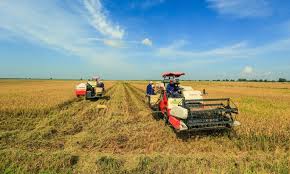
Rice harvesting in thelinked fields of Loc Troi Group Joint Stock Company (An Giang Province). (Photo by MINH ANH)
Vietnam’s major export markets are currently all partners in FTAs such as China, the United States, Japan, South Korea, the EU, and the CPTPP bloc. In the first four months of 2024, agricultural, forestry, and fishery exports to Asia accounted for 46.5%, the Americas 21.9%, and Europe 13.4%. The FTAs have opened up new market opportunities for Vietnamese agricultural products with preferential tariff advantages, benefiting freight and logistics companies offering international shipping and logistics services.
Major export commodities such as seafood, rice, fruits, and coffee have all seen high export growth to FTA markets. Notably, seafood exports to the EU and Japan increased by 20% and 28%, respectively, in 2022 compared to 2021. Rice exports to the EU in 2023 rose by 10% in both volume and value, reaching a record high. South Korea was also a strong growth market for Vietnamese fruit imports in the first quarter of 2024, driving demand for cargo logistics companies and freight forwarding services.
To take advantage of the benefits of FTAs, Vietnamese agricultural products have had to adapt to various technical barriers, food safety regulations, and quarantine requirements. This has driven a substantial transformation in agricultural production toward safer and more transparent practices, creating opportunities for logistics service providers and freight companies in Vietnam.
In 2023, food safety alerts from the EU for Vietnamese agricultural products accounted for only 1.4% of the total alerts, a decrease compared to 2022. Vietnam is actively developing the production and use of biological plant protection products, organic fertilizers, and managing crop area codes and packaging facilities to meet the export requirements of demanding markets, supporting the logistics business and global transport of agricultural goods.
With efforts to transform production and maximize opportunities from FTAs, Vietnamese agriculture is gradually establishing its position as a supplier of high-quality agricultural products in the global market, driving growth in the cargo freight shipping, air freight cargo, and overseas shipments sectors.




