

Thailand is Vietnam’s Largest Export Market in ASEAN
Data from the General Department of Customs paints a bright picture of trade activities between Vietnam and ASEAN countries in the first eight months of 2024. With a total trade value reaching $54.9 billion, a 12.5% increase compared to the same period last year, the economic relationship between Vietnam and its Southeast Asian neighbors is becoming increasingly profound and diverse.
In the export sector, Vietnam has made a notable impact with $24.6 billion in exports, up 12.6%. Thailand continues to hold the top position with $5.23 billion, while Indonesia and the Philippines follow closely with impressive growth rates. This surge is creating a new wave of demand for cross-border transportation services, particularly maritime and road transport within the region.
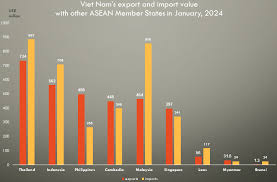
Thailand is Vietnam’s Largest Export Market in ASEAN
Singapore and Brunei have emerged as rising stars with stunning export growth rates of 26.3% and 569%, respectively. These figures not only reflect the rapid changes in the regional supply chain but also pose challenges for logistics companies to capture and meet this emerging demand in a timely manner.
On the import side, Vietnam spent $30.2 billion on purchasing goods from ASEAN countries, marking a 12.4% increase. Thailand, Indonesia, and Malaysia continue to solidify their positions as major suppliers to the Vietnamese market. This situation is driving transport companies to continuously innovate and optimize the import process while opening opportunities to develop specialized logistics services for each market.
Brunei and Cambodia have surprised with exceptional import growth rates of 252% and 28.4%, respectively. This shift in the supply chain is creating new demands for forwarder companies, forcing them to flexibly adjust their strategies, potentially by establishing new transport routes or strengthening cooperation with local partners.
Despite recording a trade deficit of $5.6 billion with ASEAN, this situation presents a golden opportunity for international shipping services to optimize empty container usage and balance bidirectional transport flows. This could be the key for logistics companies to enhance operational efficiency and reduce transportation costs.
Notably, the top six markets dominate 97% of Vietnam’s exports and 95% of its imports with ASEAN. This suggests that transport companies should focus their resources on developing specialized services for these key markets to maximize effectiveness and optimize operational costs.
However, the potential of emerging markets like Brunei and Laos should not be overlooked. These markets could be fertile ground for transport companies looking to explore unique logistics solutions that cater to the specific needs of these niche markets.
Overall, the growth wave in Vietnam-ASEAN trade is opening a new horizon for the logistics industry. To seize this opportunity, transport companies need to be agile in adapting to new trends, boldly invest in technology, and expand their network of regional partners. By doing so, the logistics sector can not only serve as a trade bridge but also become a crucial driver of deeper economic integration in Southeast Asia.




